
People are wired by Nature to seek symmetry. People with regular features are seen as more attractive than those with variations between the two halves of their face or body. We like things in our environment to be symmetrical too, and we notice things that have a pleasing symmetry about them. and then, there are those, like me, who pay attention to symmetry in numbers. When I had my previous car, I particularly watched for odometer readings that were palindromic (the same read forwards and backwards). I took photos when they appeared!


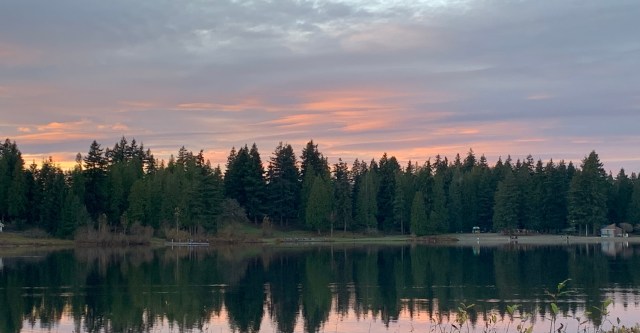
Reflections in water always add symmetry, but top-to-bottom instead of side-to-side. My local lake always offers great reflections.
And another local lake offered a dock which added symmetry.

When we were in Vancouver BC in August, we drove over the Lion’s Gate Bridge, a study in symmetry.

Suspension bridges like this one require symmetry-if they are unbalanced, they break.
These two trees in a local park look like they could be mirror images.

But not quite. Sometimes, too much symmetry can be boring or uninteresting.
The Library of Congress is a beautiful building, both inside and out, and was designed to be classically symmetrical, but not overly so.
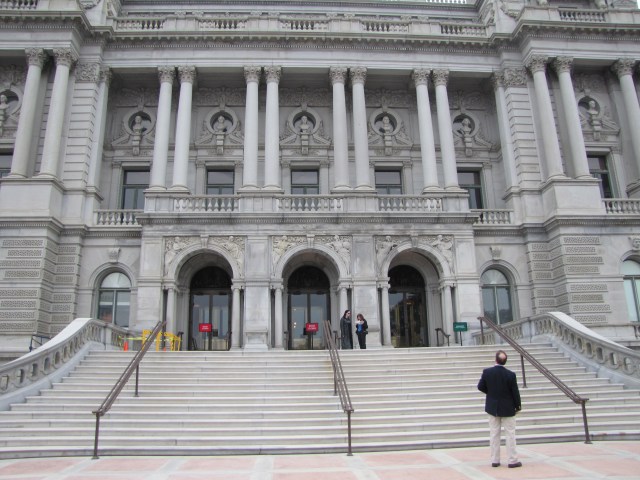
The outside is classically symmetrical, with evenly-spaced columns and doorways, and the wide staircase is also symmetrical, and quite pleasing.


The inside also is classically-designed, with evenly-spaced niches and columns. But the inserts in all those niches are different paintings and sayings relating to civilization and its effects and ways of being recorded for posterity. It really is an awe-inspiring building.
Farmers tend to plant their crops in even rows, so machinery can be used for harvesting and fertilizing. Nowhere is that better-reflected than the tulip and daffodil fields of the Skagit Valley in Washington.


Nature itself, on the other hand, is rarely very symmetrical. In fact, that’s how archaeologists detect the presence of human societies on the land, even under thick jungle. Straight lines indicate humans at work.
Here’s the Link to Sofia’s Original Post. And Tina’s too.
 Calling-all-RushBabes
Your trees could be twins 🙂 Love the bridge and the dock photos, great shots.
Thank you.
Some beautiful symmetry this week RB. Loved the closing flower fields especially.
Clever use of symmetry with palindrome. Particularly loved the dock, bridge, and and daffodil field. Very nice!