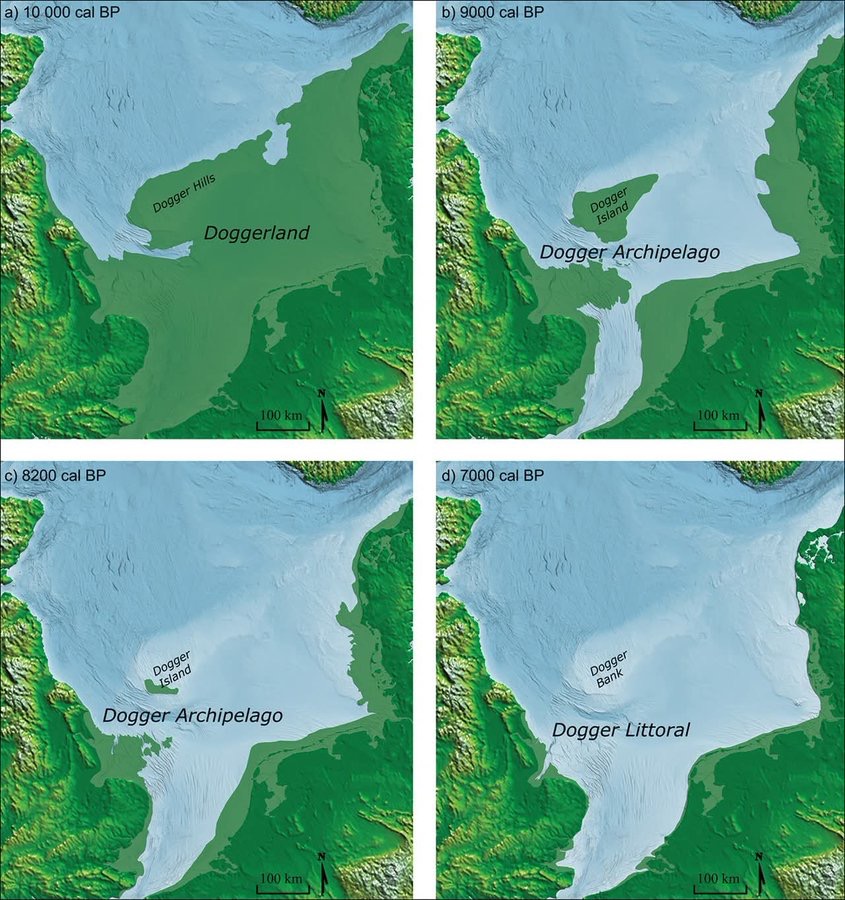
Did you know that England and Ireland have not always been islands, separated from mainland Europe? Well, the below post shows how that went down (literally!).
Doggerland is all that we have left. Doggerland was a vast, now-submerged landscape that once connected Britain to continental Europe, forming a broad plain across what is today the southern North Sea.
For thousands of years during the last Ice Age and the early Holocene, this region was not sea at all but a rich, inhabited land of rivers, forests, marshes, and grasslands. At its greatest extent, around 20,000–15,000 years ago, Doggerland stretched from eastern England across to the Netherlands, Denmark, and northern Germany. It was crossed by major river systems, including ancient versions of the Thames, Rhine, and Elbe, which joined into a vast delta flowing northward.
These waterways supported abundant wildlife such as mammoths, woolly rhinoceroses, deer, wild horses, and aurochs, making the land highly attractive to Stone Age hunter-gatherers. As the last Ice Age ended and global temperatures rose, massive ice sheets melted, causing sea levels to rise steadily. Over thousands of years, Doggerland slowly shrank as the sea flooded its low-lying plains.
By around 7000–6500 BC, it had become a network of islands, wetlands, and shallow seas. One of the final blows came around 6200 BC, when the Storegga submarine landslide off the coast of Norway triggered a huge tsunami that swept across the North Sea basin, devastating what remained of the land and its human population.
By about 6000 BC, Britain had become permanently separated from Europe, turning Doggerland into seabed. Evidence of this lost world comes from fishing nets, dredging, and oil-rig surveys, which have recovered stone tools, bones, antlers, and even fragments of human skulls from the seafloor. Advanced sonar mapping has revealed ancient river channels, hills, and valleys buried beneath the sediments of the North Sea.
Doggerland is now one of the most important archaeological landscapes in Europe, a reminder that human history includes not just lost cities, but entire lost continents, erased by rising seas at the end of the Ice Age. It must be incredible for the fishermen when they bring up prehistoric relics in their nets.
Isn’t that just the most fascinating? I think so.
 Calling-all-RushBabes