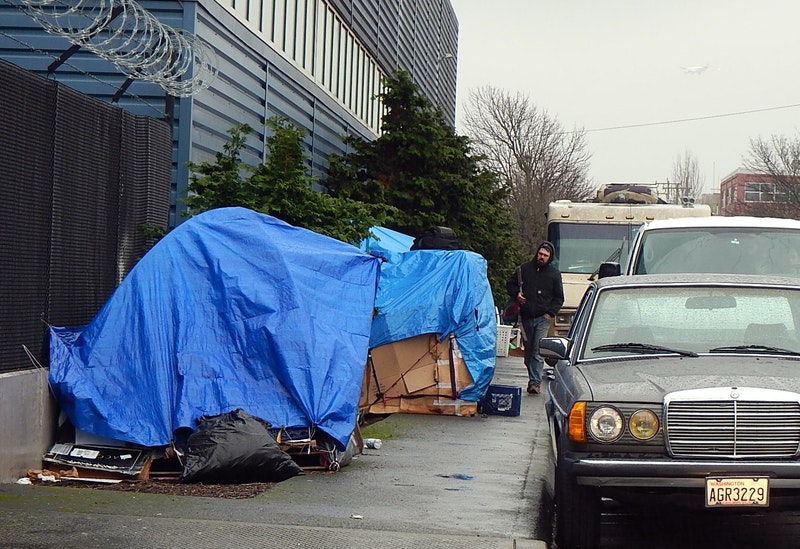
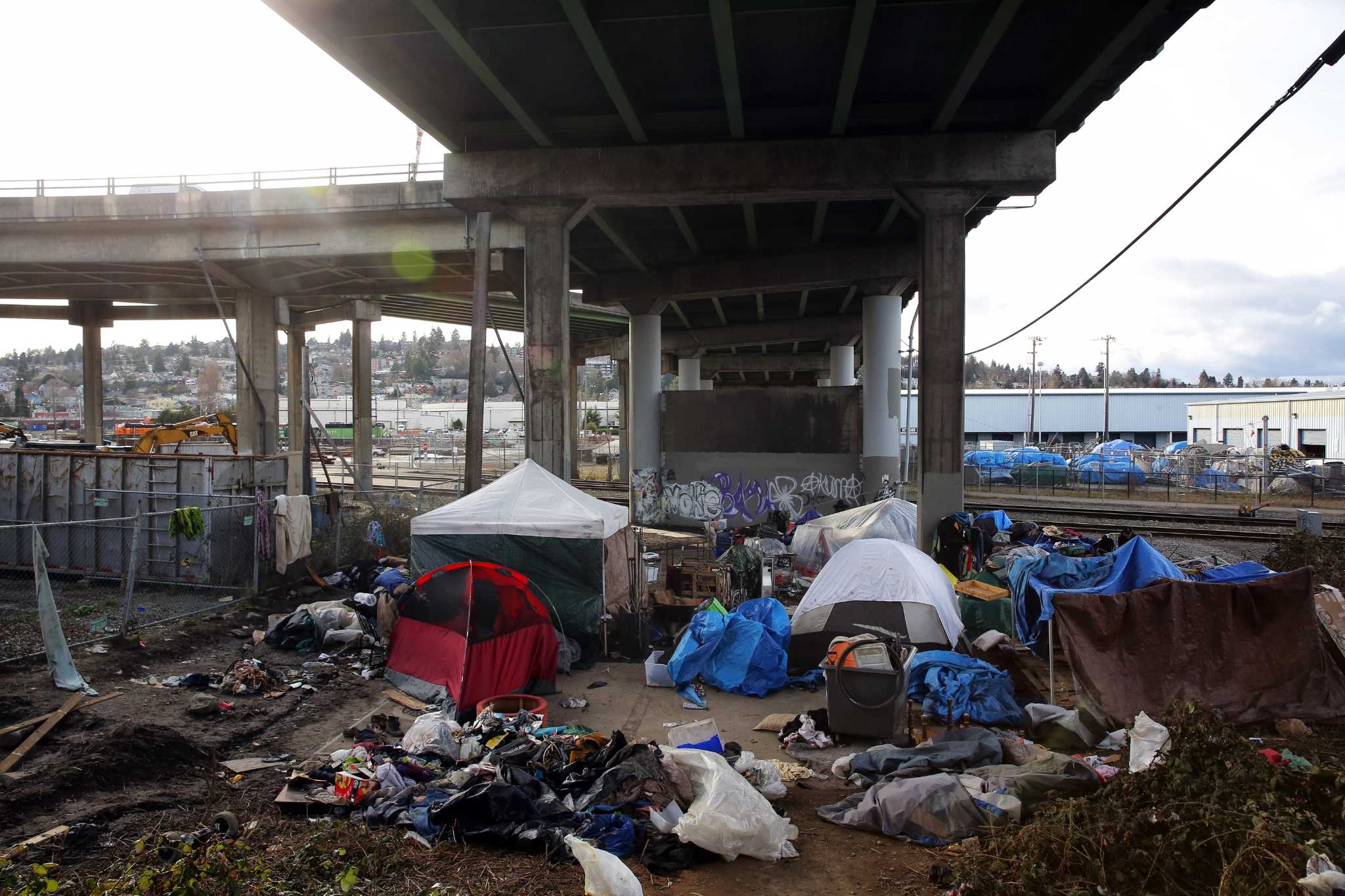
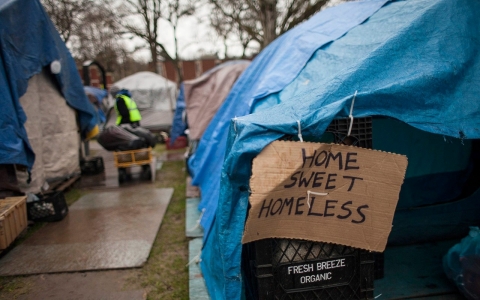
The Seattle area, where I have lived for most of my 76 years, has a large and growing homeless population. People actually come here from all over the country, to take advantage of all the consideration and services lavished on the homeless. Nearly everywhere around this area, you can see homeless tents on sidewalks, in parks, and in vacant lots with derelict buildings. Here are some examples.


The Seattle vicinity has a couple of policies that have contributed to the always-increasing number of homeless vagrants on the streets, and there is little prospect of change. The first policy is the over-arching “Housing First” delusion, which says that first, you need to get the homeless off the streets and into housing, and only then can you solve their multiple problems, like mental illness, drug addiction, criminal activity, and unemployment. However, one particular facet of that policy immediately undermines the “housing first” policy, and that is the provision of so-called “low-barrier” housing.
An organization called Plymouth Housing is in the business of homeless housing-first, and their policy is allowing drug-addicted people to bring their drug use (and sales) INTO their new housing units. They then should participate in counseling or detox, to fix the drug habit. But that part of it never seems to happen, and few people ever kick the habit once they have moved off the streets. This policy leads to residents using drugs in their units, causing fires, and units to be neglected and ultimately destroyed from within.
The other detrimental policy is allowing street vagrants to reject offers of help. All the cities do is OFFER help, and once that offer is rejected, the vagrants are allowed to remain in their tents on public land, continuing to use and deal drugs, commit crimes, and sell drugs and guns from their tents. No mandatory drug treatment is allowed, and the “harm reduction” policy allows cities and service-providers like Plymouth Housing to actually provide drug paraphernalia to addicts, so they can continue their habit, and ultimately die of overdoses in public.
Now, back to the notorious Plymouth Housing. They are building a new “supportive” apartment building in Redmond, an upscale suburb east of Lake Washington. Redmond is remodeling much of their business district, since a new light rail line was extended there. The city government approved this building, mostly keeping the public unaware of what they were doing. Because of that unawareness, a local developer has started building a new luxury apartment building on one side of the formerly vacant lot, and there just so happens to be a daycare business on the other side of that lot. Below is a story from the KOMO (Seattle’s ABC station) web site, about Plymouth and the ground-breaking for the new homeless shelter. The headline reads “Public kept out of groundbreaking for new homeless facility in Redmond”. I am including the entire story here, so it all hangs together for my readers. Emphasis and color mine.
REDMOND, Wash. — A groundbreaking event for a homeless facility in Redmond stirred new controversy when members of the public were not allowed in.
The project had already raised concern among many neighbors and keeping them out of Wednesday’s celebration only deepened their mistrust.
Housing for the homeless, complete with on-site support services, is desperately needed in so many communities. City officials designated a lot at 16755 Cleveland Street, not far from Redmond Town Center, to become Plymouth Housing’s next permanent supportive housing site. It will offer 100 residential units to some of the most vulnerable homeless people now living on the streets.
“They have a disability. Many are veterans. They are in need of health care and when they become stable that is the first step to recovery and becoming better,” said Karen Lee, the CEO of Plymouth Housing the nonprofit operator.
More than 1,900 people were experiencing homelessness in east King County, according to a 2024 Point-in-Time Count. Redmond has seen a growing need for housing solutions that serve adults with complex needs, including seniors and veterans.
For all the good the project can do, it also has some neighbors and surrounding business owners calling for safeguards to prevent drug use by tenants once they move in. At its other facilities, Plymouth Housing does not require drug testing. They subscribe to a Housing First model and work with people to help them in their recovery from drug addiction.
“They are in supportive housing but they’re still doing drugs,” Rosenthal said, pointing to the way other permanent supportive housing facilities are run by Plymouth Housing.
Rosenthal owns a commercial building nearby and said if there is no ban on drug use by residents, their ongoing addictions could perpetuate the problems they already experienced on the streets. Those problems could then impact the surrounding neighborhood, Rosenthal said.
“If you had a family member and they were addicted and you brought them into your house to live, almost nobody would say to that family member, ‘You can do fentanyl in your room, but just not in the living room,’” Rosenthal said, drawing a connection to the ban on drug use in public areas in many of these types of facilities.
For its part, Plymouth Housing plans to staff the facility around the clock and provide a variety of supports for residents, including medical care, drug treatment, mental health services and more.
“It’s about dignity and it’s about providing the platform so that individuals can really rejoin our community, with case management support,” Lee said. “We really want to allay any concerns that people have because many people really don’t know about permanent supportive housing.”
Rosenthal and others want more concrete assurances that problems won’t spill out into the surrounding community. He went to the facility’s groundbreaking ceremony on Wednesday but wasn’t allowed to enter. He said it only adds to the sense of mistrust that the public was excluded from what will become a permanent and controversial part of the neighborhood.
“They didn’t want the public coming. They only wanted the homeless agencies to bring their people to the groundbreaking,” Rosenthal said. “They pretty much didn’t get any public input initially before doing this and now they’re following a pattern of hiding it from the public again.
Plymouth Housing staffers said all of their groundbreaking events are by invitation only.
“Our event was for Plymouth partners, Plymouth funders and for city officials,” Lee said. “That’s who we invited.”
KOMO News also reached out to Redmond city officials, who confirmed a safety and security plan as well as a code of conduct for the project were completed last week. No one was available to comment, but the city did send a statement.
“In Redmond, we are committed to providing proactive, comprehensive services to support our community members across different areas of need, including housing. We know that housing is about more than shelter – it’s about providing security, stability, opportunity, and hope. And as Redmond grows, so does our responsibility and dedication to ensuring housing for all income levels – including supportive housing like that provided by Plymouth.”
In the article above, can you see the sneer in the voice of the Plymouth Housing representative? They are basically telling you to ignore the evidence that is clear to your eyes and brain. I believe that is called “gaslighting”, and is a prime feature of Big Brother in the dystopia described by Orwell in his novel Nineteen Eighty-four. The opinions of the public don’t matter to them.
Next, I will copy some of the comments on this story, because the commenters add some very valuable information to the story.
Comment #1: Look up the salaries for the managers and executives foe plymouth housing and you will see where all the money is going dozens of them between 140k and 205k. Even worker bees are above 120k.
Comment #2: Karen Lee (Chief Executive Officer)
Other: $18,638
Compensation: $320,449
Related: $0
Comment #3: Draw a five mile radius around the site and watch property values fall. Illegal taking by the state without compensation (or consent). And, another state supported outpost of barbarism. What warlord will assume control of this new lawless territory?
Now, let’s see what some other local journalists have to say about this situation.
Since statistics have shown for years that this kind of approach not only does not do what the politicians say it will do, it makes the problem worse! But we in the Pacific Northwest have a VERY powerful “Homeless-Industrial Complex”, including the local governments; the transit agency (Sound Transit) that runs the light rail and some bus systems(the light rail is known as a rolling drug den); and non-profits like Plymouth Housing and SHARE-WHEEL, who “provide services” to the growing homeless vagrant population. All those organizations make millions of dollars off the local governments, and pay their executives huge salaries for zero results to the public who has been paying for it.
The Far-Left governments all over the Pacific Northwest are allowing this kind of destructive development as supposedly “public services helping the homeless” have caused those problems to explode. Nothing ever improves, and more and more of the public’s tax dollars are wasted paying high salaries to public and non-profit employees. Then, the legislature raises taxes on everyone, causing families and businesses to close and leave the state. But the residents of most cities keep electing them again and again. That is insane behavior.
And finally, let’s hear from a beneficiary of the housing-first policy.
 Calling-all-RushBabes
Sigh. Yet another example of how the Blob/Deep State/Grifter Mafia have robbed this country blind for decades, enriching themselves and their cronies at our expense. The Ninth Circle ain’t deep enough for some of these.
Pingback: Instapundit » Blog Archive » THE MORE MONEY YOU SPEND ON HOMELESSNESS, THE MORE HOMELESSNESS YOU BUY: How NOT to solve the “
The problems are not only the “pet people” (aka, the homeless), the problems are also the corruption of the pet peoples “keepers.”
Field of Dreams: If you build it they will come.
They list over $30 million !!!! dollars in grants on their IRS tax forms. That’s taxpayer money. They list themselves on their IRS forms as an organization that “receives a substantial part of its support from a government unit or from the general public” (obviously the former here). Last data available 2022 (which is normal).
The last CEO, Paul Lambros, was reported at a salary of $250,000. He left in 2022.
Andrea Carnes, COO, same. Left in 2024 after 13 years.
A list of six employees making between $120K and $200K.
For reference, I am a high school teacher with over 20 years of teaching experience, making $120K. Maybe I’m in the wrong business.
Also, independent contractors, Slalom LLC gets $750K for “business consulting”, Davon Evans got $140K for “trash removal /biohazard/relocation services”, SAAN SAETEURN got $130K for “windows and doors”, and Stephen Group International collected $125K for security services.
Finally, doing a quick search on Data Republican’s search engine there appear to be three active grants, totaling about $1.75 million per year.
https://datarepublican.com/award_search/?keywords=%22plymouth+housing%22
Link here to the IRS data: https://projects.propublica.org/nonprofits/organizations/911122621/202322849349301872/full
Wow! You really did some great research! What would happen if Trump canceled Seattle’s federal funding? The whole system would collapse in a heap. I sure hope he calls their bluff. It’s not just the government. Seattle voters are primarily responsible. They voted for the “whole of education” sexualization of their children from kindergarten. In a way, they deserve the results.
https://www.heritage.org/housing/report/the-housing-first-approach-has-failed-time-reform-federal-policy-and-make-it-work
A good article on the failure of the “housing first” model