The world situation being what it is, I figure it’s time for some endearing animal and human-interest stories. So here they are.
First, from one of my X Cat accounts:
🇯🇵 TAKESHI: THE RARE MALE CALICO CAT WHO SURVIVED AN ANTARCTIC WINTER AND AN ELECTRIC SHOCK
In November 1956, a little male calico cat named Takeshi embarked on an extraordinary journey aboard Sōya, the Japanese expedition ship bound for Antarctica.
Male calico cats are exceptionally rare and were traditionally considered lucky in Japan. Given to the expedition shortly before departure, the kitten was welcomed aboard as a good-luck mascot for the voyage.
He was named Takeshi after the expedition leader, Takeshi Nagata.
In 1957, Takeshi became a beloved companion to the members of Japan’s first Antarctic wintering expedition at Showa Station.
While the researchers worked in the extreme Antarctic environment, Takeshi explored the station, spent time with the crew, and even played with puppies born there.
He was particularly close to radio operator Toshio Sakuma. According to the National Institute of Polar Research, Takeshi sometimes slept in Sakuma’s sleeping bag and followed him when he went outside.
But on October 30, 1957, the little cat nearly lost his life.
Seeking warmth, Takeshi crawled inside a large piece of radio equipment in Sakuma’s room and accidentally touched a high-voltage wire.
He suffered an electric shock. There was reportedly a smell of singed fur.
The expedition members cared for Takeshi, but he continued sleeping for days.
Then, one day, Sakuma was walking outside when he noticed a familiar little figure following him again.
It was Takeshi.
The cat had recovered and was back to his usual routine.
In February 1958, after surviving the Antarctic winter, Takeshi returned from Showa Station to Sōya by helicopter with members of the expedition.
During the voyage home, the crew even provided him with a specially made little life jacket.
Takeshi returned safely to Japan in 1958 and became a member of Sakuma’s family.
But his story had an unexpected ending.
About a week after arriving at his new home, Takeshi disappeared. His whereabouts were never established.
Although his final fate remains unknown, his remarkable journey has been preserved through photographs, film footage, and historical records held by Japan’s National Institute of Polar Research.
Among the famous sled dogs and pioneering Antarctic explorers, there was also a small calico cat who survived a dangerous accident and shared an extraordinary winter at the edge of the world.
His name was Takeshi.
Cats really do have nine lives!!
Kids and a horse.
Next, a tale from Japan. You will see more from this nice man on my blog!
My father had never been on a plane for more than two hours. He doesn’t speak a word of English.
But for a month, every night, I heard him in his room practicing one English sentence.
Last month, he flew fourteen hours to Iowa.
Some of you know why. The farmer. The big man in the seed cap who sat next to him at my sister’s wedding and shared a bottle of sake with him for three hours, without a single word in common. My sister’s host father. He passed away in August.
My sister went with him to translate. She says he wore his best suit the entire flight. He didn’t sleep. He sat up straight for fourteen hours, like he was already standing at the grave.
At the airport in Des Moines, four huge men were waiting. The four sons.
They were holding a sign in Japanese. They had spent two days copying it, stroke by stroke, from a text my sister sent them.
“Welcome home, Father.”
One of the characters was upside down.
My father looked at that sign for a long time. Whatever English he had practiced, it didn’t come out.
He just bowed. Low.
The four brothers didn’t know what to do. So they bowed back. Four Iowa farmers, bowing in the middle of the arrivals hall.
That night, their mother made pot roast. My father had seconds. She gave him thirds. He didn’t say no. In my whole life, I have never seen my father take seconds.
After dinner, she brought out something and put it in his hands.
Her husband’s seed cap.
Nobody said anything. My father held it with both hands, like it was made of glass.
The next morning, they took him to the grave.
He had brought a bottle of sake. The same brand from the wedding. He knelt down and poured one cup for his friend and one for himself. In Japan, that’s how you share one last drink.
The brothers didn’t know the custom. The oldest walked back to his truck and returned with four cans of beer.
They knelt in the grass beside him. Five men. One grave.
Then my father put on the seed cap.
And very slowly, in English, he said the sentence he had practiced for a month.
“I am… his friend.”
Not “was.”
Am.
The oldest brother tried to answer and couldn’t. Finally, he said, “Yes, sir. You are.”
Then it started to rain.
The farm had been dry for weeks.
My father looked up at the sky and laughed. He was crying. My sister had never seen him do either.
He came home last week.
The upside-down sign hangs next to our family altar now. The seed cap stays by the front door.
Every morning, he puts it on and checks the weather in Iowa.
When it rains there, he calls them.
They don’t share a language. They talk for twenty minutes anyway.
Mostly about the rain.
Children saved by their teacher.
Minnie Mae Freeman (later Penney), born 1868, died 1943. The two images are probably modern composites or generated art, not 1888 The amazing story is teenage teacher, roof gone, 13 kids, all lived, deadly blizzard — true. Rope maybe yes, maybe “hold on tight. On January 12, 1888, the Schoolhouse Blizzard (also called the Children’s Blizzard) slammed the Great Plains after an unseasonably warm morning. Winds tore the door and then the roof off Minnie Freeman’s sod schoolhouse in Mira Valley, near Ord, Nebraska. She was about 19. She led her 13 students through the storm to a farmhouse. Everyone in her group survived. The storm killed an estimated 235 people across the Plains (some later estimates run higher; Nebraska deaths are usually put at 40–100). 1888 newspapers and later Nebraska histories said she tied the children together with twine or a tug-of-war rope and carried the smallest child. That version stuck and even appeared on sheet-music art. One former pupil, Emma Lee, later said they were not tied: they walked two by two and held onto the person ahead. Both versions exist in the record. The rescue itself is not in dispute. Almost no one remembers” That part is wrong. She became nationally famous at the time: a parlor song, Thirteen Were Saved, or Nebraska’s Fearless Maid; a gold medal from the state education board; a wax bust on tour; a mural in the Nebraska State Capitol; a historical marker south of Ord. The New York Times ran an Overlooked obituary for her in 2018. In Nebraska history she is the best-known teacher from that storm. However maybe no one today remembers and I am sure there are decedents of the survivors who may have forgotten Lets remind them that one brave teacher is why they are here
Another Baby video. These are almost as addictive as cat videos.
In case you didn’t know, the Belgian Malinois is the smartest dog breed. They can learn almost anything, and are fiercely loyal to their owners, and protective of them. They are VERY athletic, and make excellent military and police dogs.
Ruby is a 1-year-old Belgian Malinois who was left at a shelter by her previous family because they “no longer had time to care for her.” When she was taken out of her kennel, Ruby looked sad and kept glancing around, as if waiting for her former owners to come back for her.
The person filming posted Ruby’s story online. Within just a few hours, a woman named Kimberlee (a former U.S. Air Force veteran who served for over 30 years) saw the video even though she didn’t follow the channel. She was deeply moved and immediately drove through the night, traveling five hours to arrive at the shelter’s door right when it opened the next morning.
Kimberlee had lost her husband eight years earlier, so she understood the feeling of needing an unconditional companion.
In less than 24 hours, Ruby already had a new home! She has now been renamed Ruby Anne, follows her new mom everywhere, sleeps in her bed, plays with her two new “sisters,” and is in charge of “monitoring” the local squirrels. Kimberlee even wore a hat that said “There is no place like home” when she came to pick her up. 💖✨
Finally, one more horse story. This is a horse that I would just love to meet. Isn’t he beautiful?
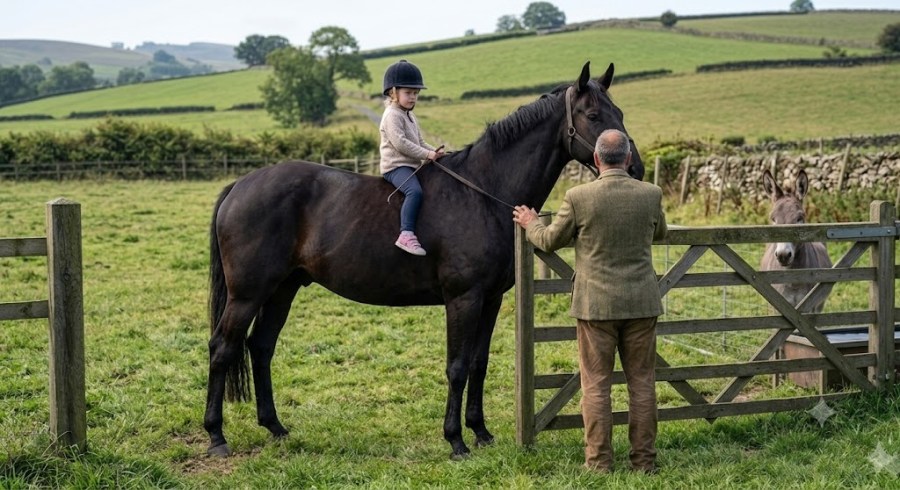
Hector stood for four minutes on Saturday with a four-year-old girl on his back, and did not move a muscle he had not been asked to move.
You need both halves of this horse to see why that is worth writing down.
The first half is the one people know. Seventeen years a Cavalry Black in the Household Cavalry, the better part of seventeen hands of Irish-bred gelding, trained across all of it to master the single instinct every horse is built around, which is to run. He carried troopers down the Mall in a steel breastplate through massed bands and saluting guns and a hundred thousand people. He walked behind a gun carriage at a state funeral at the slow march, drum beating the step, a nation watching through its tears, and he never put a hoof wrong.
The second half is the one his field knows. Hector is undone by a pheasant. A carrier bag on the wind is, to him, a clear and present danger. He will levitate sideways away from a hedge that has done nothing to anybody, and he does this in a quiet Welsh field at twenty-one years of age with a small grey donkey standing four feet away not bothering to look up.
Both are true at once. The guns were a job and the job had rules. The hedge has no rules and a pheasant in it, and the flight animal underneath all that training remains, on the matter of pheasants, entirely undefeated.
The man who groomed him and rode him through those years still comes, whenever the long drive allows, which is more often than a man of his age has any reason to manage. He brings nothing and asks for nothing. He stands at the rail. Hector knows the engine in the lane before the car is in sight.
On Saturday he brought his granddaughter.
She is four. She has heard about this horse her entire short life and had, until Saturday, understood him to be roughly the size of the dog.
They put the smallest hat in the tack room on her. Her grandfather lifted her up, and the old horse stood, and something switched over behind his eye that nobody in that field had seen in years.
He did not doze. He did not rest a hind leg. He came up off the leg he had been resting, squared himself, and held. Ears forward, weight even, the whole enormous machinery of him gone quiet and formal, because a rider had gone up, and a rider going up has only ever meant one thing.
He was on duty.
Nobody at that rail said a word. There was nothing worth saying over the top of it.
They walked twenty metres up the fence line and twenty back, at a walk you could have set a watch by. Her grandfather had one hand on the girl and one on the rein and neither of them was doing anything, because there was nothing to do. The horse knew the job. The horse has never once in his life needed telling what the job was.
Then she was lifted down, and the shape went out of him, and he dropped a hip and let his bottom lip go soft and became again an old woolly gelding standing in a wet field in Denbighshire.
Nelson watched the entire proceeding from the dry corner with the good hay unguarded behind him, which tells you precisely how much of it he considered worth attending to.
On the way back down the lane the girl asked her grandfather whether Hector was famous.
He said he used to be.
He knew it was the wrong answer before he reached the car, and he has not stopped thinking about it since.
Happy Feel-Good Friday, everyone!

