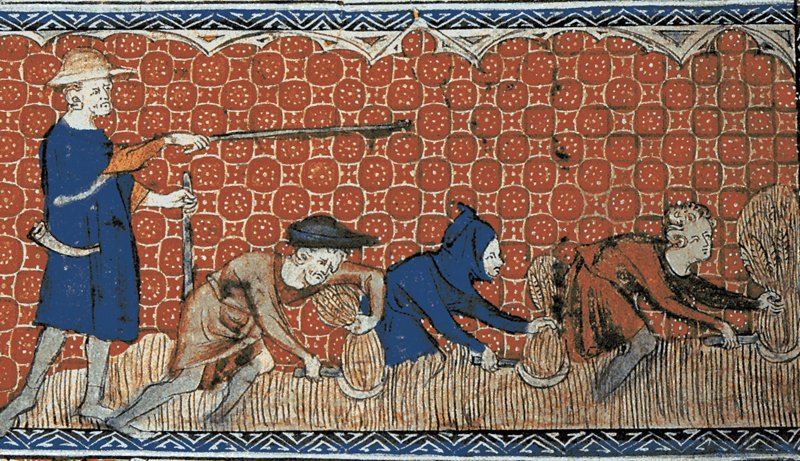
I am reading Thomas Sowell’s book “Wealth, Poverty, and Politics”, and his discussion of the many factors that affect what kind of society results from a variety of geographic, demographic, social, and genetic factors interacting. For a long time, I have thought about societies like those in Russia and most European and Asian countries in the past, where the majority of people were what can be called “poor peasants.”
For much of human history, most places where people settled down and engaged in agriculture (not including nomadic societies who wandered from place to place mostly raising animals), the majority of the people in those places were peasants, extracting a living from fields of crops, and raising some animals for food, milk, hides, and other byproducts. Most of them had no good way of acquiring material wealth, and lived mostly from hand to mouth. Those fortunate enough to live on better land might extract sought-after items like metal or stone, and become expert at working those materials to build and maintain houses and public buildings, thus acquiring more wealth and becoming officials in their towns. Those with more “smarts” would produce more than others, end up with a surplus they could sell to others, and gather more power and influence to themselves over time.
Those people might attract the envy of neighbors, and fighting might spring up to determine which individuals or families would have power over their fellows, and this conflict could end up with more-powerful people declaring themselves “king” over the others. Monarchies have existed as long as there has been recorded history, and they mostly consisted of masses of poor peasant farmers, with smaller numbers of merchants, artisans, and public officials. But the majority of the people could still be classed as poor peasants, with little wealth, few belongings, and little to no power.
The medieval period in Europe, with its feudal system of peasant farmers tied to the land, and large wealthy landowners having most of the economic power, was the main example of the societies of poor peasants. However, in China, this was also the case, with power residing in the Emperor and his family, and most of the rest of power residing in scholars, merchants, and skilled artisans. Most peasants had little wealth or education and few ways of acquiring them. The King or Emperor owned most of the land, and extracted taxes from everyone, in money, crops, or labor. Though most European countries lost the feudal system after the Black Death in the 1300s decimated the peasant class, giving those remaining more power over their own labor, the peasant economy remained in many places right up to the modern period.
When the Bolsheviks in Russia overthrew the government in 1917, the Tsarist economy consisted of mostly peasant farmers, ruled over by petty bureaucrats and the Tsar and his family. They were mostly illiterate, and were often oppressed by their local governments. When the Communists took over China in 1949, it was a predominantly peasant economy too, with the majority of people living on small farms with small fields and few animals. They were mostly illiterate too. In fact, though the Communists try to de-emphasize the fact, China still has a significant number of poor peasant farmers who do not have many of the benefits of modern society, and whose children must go to cities to find work to help support their families in the country.
Economies of mostly poor peasants have a hard time advancing, with the average person having no way to improve his “human capital.” In some cases. like in India when it was colonized by the British, the lot of the peasants improves enough for them to become literate and able to acquire more wealth. Many conquered places were improved by their conquerors, especially those barbarian places conquered by the Romans. Unfortunately, the Romans left so abruptly, many of the benefits they brought were lost, and had to be re-learned later. For that matter, we in modern times are still learning from the Romans!
Roman concrete, also known as opus caementicium, stands as a testament to the engineering prowess of ancient Rome. This remarkable building material played a crucial role in the construction of some of the most enduring structures of the Roman Empire, many of which still stand today. The secret to the longevity and strength of Roman concrete lies in its unique composition and innovative construction techniques.
One of the key ingredients in Roman concrete was a volcanic ash called pozzolana, sourced primarily from the region around Mount Vesuvius. When mixed with lime and water, pozzolana created a chemical reaction that produced a durable and water-resistant binder. This binder, combined with aggregates such as rubble, stones, and bricks, formed a strong composite material that could withstand the test of time.
The Romans also incorporated other additives into their concrete mixtures to enhance its properties. One such additive was seawater, which reacted with the lime to form additional minerals that reinforced the concrete and made it more resistant to erosion. This innovation allowed the Romans to build structures such as harbors, bridges, and aqueducts that could withstand the corrosive effects of seawater.
The use of Roman concrete revolutionized construction techniques in the ancient world. Its exceptional durability and strength enabled the Romans to build massive structures that have endured for centuries. The Pantheon in Rome, with its iconic dome made of Roman concrete, is a prime example of the lasting legacy of this remarkable building material.
In addition to its structural properties, Roman concrete also had aesthetic appeal. The Romans were able to mold and shape the concrete into intricate designs and patterns, allowing for the creation of visually stunning architectural masterpieces. The use of concrete in Roman architecture paved the way for the development of new building styles and techniques that would influence construction practices for centuries to come.
Despite the advances made in modern concrete technology, Roman concrete continues to fascinate engineers and historians alike. Its longevity and resilience serve as a reminder of the ingenuity and skill of the ancient Romans. By studying the composition and construction techniques of Roman concrete, we can gain valuable insights into sustainable building practices and materials that may inform future innovations in the field of construction.
Roman concrete stands as a remarkable achievement of ancient engineering and architecture. Its durability, strength, and versatility have left an indelible mark on the built environment of the Roman Empire and continue to inspire admiration and study to this day.
© History Addicts
One of the reasons that America is what it is today is its total lack of poor peasants. Europeans came to America from its beginnings with fully-formed human capital. Most were both literate and well-educated, even the women. No one was tied to the land, and techniques of farming and manufacturing were already known and advanced, ready to build a new country. Each person and family was mostly free to make its own way in the new land, with little to hold them back. Even those who came to America as indentured servants eventually worked off their debts and became free to build their own lives here. And those who came to America as slaves also were freed to build their own lives and prosper in America. Today’s blacks who demand “reparations” from our government have no claim on modern whites, who never owned slaves. They need to learn the history of their own people after the Civil War, and get to work building their lives in the Greatest Country on God’s Green Earth.
So when you are looking at the advancement and conditions inside a country today, check to see if they have masses of poor peasants, and that might explain some things. It is very well-known that, if allowed and helped to develop their own “human capital,” anyone can improve themselves in order to earn their way and improve their station in life. All the resources are out there for any average person to make themselves better able to succeed. They just need to do it.

