Robert Morris of Philadelphia had a life that really had its ups and downs. See if you don’t agree after reading these two views of his life.
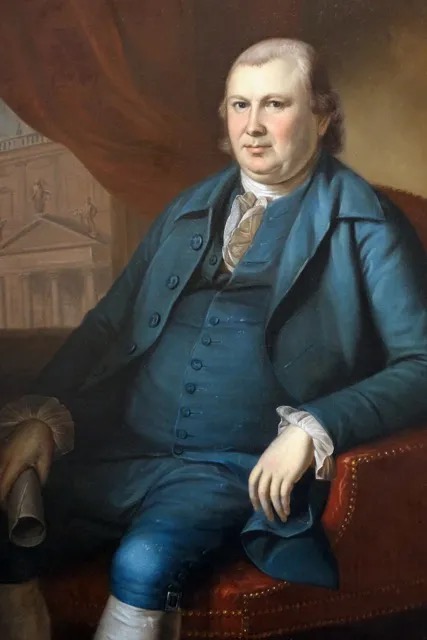
Known as “Financier of the Revolution,” Robert Morris was indispensable to the cause of American Independence—using his commercial and financial brilliance to almost single-handedly propel American war efforts through to final victory.
In January of 1734, Morris was born in Liverpool, England. His father was a successful businessman, with extensive ties to the colonies, and brought Robert, at 13, to America.
Soon after, tragedy struck, and Morris was left virtually an orphan—though he would go on to form the Willing, Morris & Co., one of Philadelphia’s most successful merchant houses.
In 1775, Morris entered public service, elected to the Pennsylvania Assembly and chosen as a Delegate to the Second Continental Congress, where he served on a number of committees.
At the start of the Revolution, he was considered the richest man in America. He worked closely with General George Washington to secure supplies, and often extended his own personal credit or borrowed from friends.
Now a very different view of Morris’s life.
The single richest man in America personally bankrolled the Revolution, kept Washington’s army alive with his own money, and then died broke in a debtors’ prison. The man who funded the country got thrown in jail for being poor.
Meet Robert Morris. If the United States has a financial founding father, it’s this guy, and almost nobody knows his name. He was born in Liverpool, England, in 1734 and came to America as a 13 year old boy. He got into the shipping business in Philadelphia and was so good at it that by 1775 he was likely the wealthiest man in all of the colonies. Ships, trade, credit, money moving everywhere. He was the money.
Here’s the wild part. At first he didn’t even want to declare independence. He thought it was premature and voted against rushing into it. But once the decision was made, he didn’t hedge. He signed the Declaration of Independence and threw his entire fortune behind the cause. And thank God he did, because the young country was flat broke.
The army was starving, unpaid, falling apart. So Morris did something almost nobody would do. He used his own personal credit and his own personal cash to keep the war going. When Washington needed money to march on Yorktown for the campaign that basically won the war, Morris helped raise it, at times pledging his own name and fortune to cover it. He became known as the Financier of the Revolution, and it’s not an exaggeration.
He kept the lights on. He’s also one of only two men to sign all three of America’s founding documents, the Declaration of Independence, the Articles of Confederation, and the Constitution. When Washington offered to make him the very first Treasury Secretary, Morris turned it down and pointed him to a young Alexander Hamilton instead.
Now the tragedy. After the war, Morris poured everything into massive land speculation, betting enormous sums on the future of the country. The bets went bad. Spectacularly bad. He ended up owing something like three million dollars, a genuinely staggering fortune for the time. And so, in 1798, the man who had personally financed American independence was locked in a debtors’ prison in Philadelphia. He sat in that cell for years.
The Financier of the Revolution, penniless, behind bars, while the country he’d funded moved on without him. He finally got out around 1801, aided by a new bankruptcy law, and lived quietly and broke until his death in 1806. A man who was richer than anyone, gave it to a nation, and died with nothing. Robert Morris. He bought America’s freedom and went bankrupt doing it.
This is not the first of the signers who I found two different stories about, and presented them here. I especially appreciate the two different portraits of each man. Some are younger, some older, and they show how people change over their lives. I truly hope my readers are enjoying reading about these remarkable men, as much as I am learning and enjoying writing about them.
Happy 250th Birthday, America!

