This will be a long essay, as I copy over reports of some of the actions being taken by various parts of the Washington State Government, to rule over every aspect of the lives of its Citizens. This is what Washingtonians like me are subjected to on a daily basis, and the State has much more in the planning stages.
First, a post about the Democrats who hold large majorities in both houses of the state legislature. Already, they can basically steamroller our weak Republicans on just about any bill proposed. They passed an Income Tax (AKA Millionaires Tax) over the objections of 89% of those who weighed in on the bill, and spoke at hearings before passage. Even Democrat citizens opposed the bill, but the lawmakers passed it anyway. Quote first, X link at the end.
EVERYTHING IS ON THE LINE IN THE 2026 MIDTERM ELECTION What a Democratic Supermajority Could Mean in Washington State August 17, 2026 The results of the August primary show that Democrats in Washington State are within striking distance of a supermajority in the Legislature. They need to win seven seats in the House and three in the Senate this November to reach the threshold. So what does it mean for one party to have a supermajority in a legislative body? To help explain this, KNKX All Things Considered host Emil Moffatt spoke with state government reporter Sarah Mizes-Tan.
Interview Transcript KNKX host Emil Moffatt: So we know that a supermajority means one party holds more than two-thirds of the seats in the House and Senate and has a lot of sway. But can you explain what powers a supermajority could unlock for that party, in this case, Democrats?
State government reporter Sarah Mizes-Tan: So a supermajority could be achieved in the Washington State legislature with just seven more seats in the House and four more seats in the Senate. There are a few things that Democrats would be able to do if they achieved a supermajority. One is that they could pass any bill or overwrite a veto by Governor Bob Ferguson without needing a single vote from Republicans.
Moffatt: So this could mean less power for the governor?
Mizes-Tan: Potentially yes. Although the governor is a Democrat and he has generally been aligned with the agenda that state Democrats have been pushing, even the most progressive of bills, like say the “millionaire’s tax” from this past session. And notably, a supermajority could mean that Democrats most powerfully could have the ability to amend the state’s constitution without pushback from Republicans. To name one item, House Majority Leader Joe Fitzgibbon has been eyeing the possibility of a supermajority, and he’s spoken before about how Democrats would be able to do mid-decade redistricting if they won a supermajority, which could really secure Democrats’ power.
Moffatt: Redistricting: A hot topic in recent years. So what concerns are you hearing from Republican leadership here in Washington?
Mizes-Tan: I think Republicans are most worried about what I just mentioned: The fact that a supermajority would allow Democrats to amend the state constitution, which would allow them to push forward a lot of legislation that has had the pushback of Republicans up until now. The Republican party in some parts of the state is already so weak that a supermajority could really just silence them. Democrats would be able to pass constitutional amendments protecting abortion, for example, or they could lower the voter approval threshold for passing school bonds, in addition to the possibility of enacting redistricting that would be favorable to the Democrats in the long run. It’s an interesting experiment to even think about how the recently passed millionaires tax might have played out differently if Democrats had a supermajority. Arguably they could have just amended the constitution to create one.
Moffatt: Are we hearing a lot of motivation from Democrats to go all-out to achieve this supermajority? And what are the potential downsides?
Mizes-Tan: I think the larger question is really if Washington State Democrats are truly motivated to get a supermajority. It’s kind of an interesting point that someone made to me recently. State Democrats don’t really have any larger issues right now that they’ve really had the entire party galvanized around. I can point to redistricting as one item and maybe enshrining abortion rights in the state constitution, but I don’t know if those are really compelling enough reasons to get that supermajority.
Washington State
EVERYTHING IS ON THE LINE IN THE 2026 MIDTERM ELECTION
What a Democratic Supermajority Could Mean in Washington State
August 17, 2026
The results of the August primary show that Democrats in Washington State are within striking distance of a supermajority… pic.twitter.com/s4e0lQUaKU
Next, having to do with the penchant our Attorney General has to sue the Trump Administration for nearly ANY actions it takes, on any subject for any reason. DC is acting to ensure, as far as they can, that federal elections are FAIR, and no cheating takes place. Knowing that Democrats in this state have cheated themselves into office for 40 years, it’s in their best interest to oppose Trump as much as they can. Emphasis mine, and please note that the AG was a partner with the Governor in Pacifica Law.
2026 MIDTERM ELECTION
Washington State, other states move to fortify elections against Trump
Attorneys general raise alarms over potential for interference in midterms
August 17, 2026
State Democratic officials are preparing for chaos at the polls this November, as President Donald Trump casts doubt on election security and pushes for more federal involvement in local voting.
“We’re no longer talking about hypothetical situations,” said Nick Brown, Washington State’s Democratic attorney general, noting the president’s push to nationalize election administration and to question the integrity of upcoming elections.
Brown is among the many Democratic state officials raising alarms over how Trump may seek to interfere with or challenge the results of November’s midterms. At stake is not only whether Republicans will maintain their grip on Congress, but also the control of state legislatures across the country. Democratic gains at either the state or national levels could provide a new check on Trump, who has sought to significantly expand executive power in his second term.
State lawmakers have introduced new legislation this year with the aim of protecting polling places this November. And behind closed doors, Democratic attorneys general and local election officials have sought to anticipate and prepare for ways the federal government could interject itself into local elections.
In recent months, Democratic attorneys general have been meeting to prepare for worst-case scenarios — including the possibility of federal immigration officers patrolling polling locations or the FBI visiting county election offices. Those AGs are gearing up to immediately fight potential intimidation or interference efforts in court, Brown said, and are working to educate local election administrators on basics of election law.
“Absent some very unusual circumstances, you can’t send the military to polling locations just to hang out. You can’t do those sorts of things,” he said.
The White House did not respond to Stateline’s questions. Republican state officials told Stateline they will respect voting laws and the outcomes of local races; no matter how the president reacts. Some Republicans have opposed Trump’s efforts to restrict mail-in voting and resisted requests for private voter data.
Brown said he’s less worried about a White House effort to cancel or attack the legitimacy of elections across the country. Rather, he fears a more targeted effort to interfere with or challenge results in a few states that could determine the balance of federal power.
The president still refuses to acknowledge his 2020 electoral defeat, and Brown noted some fellow election deniers now hold power in state and local governments. At least 25 county election officials who align with the broader election-denier movement have taken office across the country since the last federal election in 2024, according to a recent New York Times analysis.
“That is what worries me, is a half a dozen local elected officials saying I have doubts about the election because the president said there was something shady, and I’m not going to certify it,” Brown said. “And we’re just in a chaos moment. And I think that’s a very real possibility.”
He added: “The struggle I have often in this job, and particularly on this issue, is raising the alarm for people about these possibilities, while not sounding like an alarmist, but I think we really need to in this circumstance.”
Utah Republican Gov. Spencer Cox said elections have always had “some issues,” but he said there’s no evidence of anything coming close to major voter violations of election laws in the recent past. He said he expected Republican and Democratic secretaries of state to continue their long tradition of conducting elections with integrity.
Washington State
2026 MIDTERM ELECTION
Washington State, other states move to fortify elections against Trump
Attorneys general raise alarms over potential for interference in midterms
Now, our litigious AG sued Kalshi, a “Prediction Market” where people can bet on all sorts of activities. He won his case. Here is a description of the case, and who benefits from this judicial win. Hint: It’s not the average Washington taxpayer.
Sovereign Indian Tribes Control The Evergreen State
Kalshi Ordered to Geofence Washington Bets by Sept. 2 as Tribes Push for Supreme Court Review
A King County judge ordered Kalshi to geofence Washington bettors out of sports and event contracts by Sept. 2, a ruling tribal gaming leaders say brings the fight closer to the Supreme Court.
August 16, 2026
A Washington State judge has ordered Kalshi to shut down most of its sports and event-contract trading in the state by September 2, dealing another courtroom loss to the prediction market operator and fueling tribal gaming leaders’ hopes that the U.S. Supreme Court will soon settle the legal fight once and for all.
King County Superior Court Judge John McHale issued the order on August 13, finding that Kalshi is likely violating Washington’s gambling laws by offering event contracts on sports, elections, politics, entertainment, culture, tech, science, and “mentions” markets. The company must implement IP address and residency-based geofencing by August 19, followed by a more sophisticated multi-source geofencing system by September 2. Contracts tied to commodities, climate, economics, and finance are not affected by the order.
Kalshi denied a stay, faces steep daily fines
Kalshi immediately asked the Washington Court of Appeals to pause the injunction while it appeals, but the court denied that request. If the company misses the September 2 deadline, it faces fines of $120,000 per day, though it can submit an affidavit explaining any delay for the court to consider. McHale wrote that Kalshi “willfully ignored” a December 2025 notice from the Washington State Gambling Commission stating that event-based contracts were not authorized in the state, and concluded that the public interest in protecting consumers outweighed any harm to Kalshi from the order.
“Kalshi is regulated by the CFTC (Commodity Futures Trading Commission), which has exclusive jurisdiction over our exchange,” Jackie McGavick, a spokeswoman for Kalshi, told CDC Gaming in an email. “We respectfully disagree with the court’s decision and are considering all legal options.” The order is part of a preliminary injunction the court first granted in July, and the underlying case is still moving toward trial. Washington is now one of at least three states, alongside Michigan and Nevada, where judges have ordered Kalshi to geofence its sports-related offerings.
Tribal leaders see momentum building toward the Supreme Court
The ruling landed as a win for the Indian Gaming Association, which represents tribes that argue prediction markets offering sports wagers threaten both tribal economies and tribal sovereignty. Washington is home to 23 federally recognized tribes operating 29 casinos. Jason Giles, executive director of the IGA, called the decision “another victory” in a string of recent wins for tribal gaming interests, including a federal judge’s ruling that Utah can enforce its own anti-gambling laws against Kalshi.
“I think it should give some impetus for the U.S. Supreme Court to weigh in sooner rather than later,” Giles said. He added that Congress also has a role to play in addressing the argument that sports-related event contracts should be treated as financial swaps rather than wagers, and said lawmakers should hold oversight hearings on the CFTC’s posture toward prediction markets.
IGA Chairman David Bean was more pointed in his criticism, accusing CFTC Chairman Michael Selig of “prepping the industry for the Supreme Court” rather than reining in an unregulated product. Bean argued during a recent IGA webinar that the dispute also implicates the Indian Gaming Regulatory Act, which gives states a say over tribal gaming within their borders. “We are dealing with a captive regulatory agency in the CFTC,” Bean said. “When have you seen an agency advocate on behalf of the people they are supposed to regulate.”
Washington State
Sovereign Indian Tribes Control The Evergreen State
Kalshi Ordered to Geofence Washington Bets by Sept. 2 as Tribes Push for Supreme Court Review
A King County judge ordered Kalshi to geofence Washington bettors out of sports and event contracts by Sept. 2,… pic.twitter.com/v33LPfpFDJ
Long ago, when Indian gambling was first approved in Washington by Democrat Governor Christine Gregoire, the tribes were given carte blanche to open their casinos on their reservations with little oversight. They were also given 100% of the profits from all their allowed gambling, with NO cut for the State. So Washington gave the various Indian tribes here a huge financial windfall, and larger tribes like the Tulalips and Muckleshoots are becoming very wealthy and powerful.
Speaking of Indian Tribes in Washington…
Washington State August 16, 2026 Our glorious, powerful totalitarian leaders in Washington State may as well just sign over the entire state of Washington State to the Sovereign Indian Tribes.
The state Legislature has already done that through SB 6034 (2026) and through the Public Trust Lands Transfer (TLT) Program being operated since 1989 via Washington State Dept. of Natural Resources (DNR). The goose is already cooked. https://dnr.wa.gov/land-transactions/trust-land-transfer
Decades after the rogue practice of transferring public trust lands to Sovereign Indian Tribes and to conservation environmental NGO groups, the Washington State Legislature codified into state law the Public Trust Lands Transfer Program in 2023 via HB 1460 (2023).
Read the Roll Call and see who voted YES on HB 1460 (2023). https://app.leg.wa.gov/billsummary?BillNumber=1460&Year=2023 ☆☆☆ There’s no point in complaining about the situation because the People have NO power. We the People are subservient taxpaying slaves to the state and county government and to the Sovereign Indian Tribes.
Washington State
August 16, 2026
Our glorious, powerful totalitarian leaders in Washington State may as well just sign over the entire state of Washington State to the Sovereign Indian Tribes.
The state Legislature has already done that through SB 6034 (2026) and through the… pic.twitter.com/jgpJdVXqZf
Yes, the State Government is just handing over State land to Sovereign Indian Tribes, taking land from the productive Tax Base of the State, when their spending is so out of control the State is running huge deficits and raising taxes right, left, and center. Taxpayers are getting squeezed in four dimensions.
EVERGREEN STATE ON FIRE
Wildfires have scorched ALL of Washington State’s national parks Ninety-five large, uncontained fires are encroaching on iconic destinations like Mount Rainier National Park in Washington and Mount Hood National Forest in Oregon.
The Border 2 Fire on Aug. 7, 2026 in North Cascades National Park, Washington. The Border 2 Fire blanketed North Cascades National Park in Washington in smoke Friday.North Cascades National Park Service
By Alicia Victoria Lozano August 13, 2026 The numbers are staggering: Wildfires this year have consumed more than 6.4 million acres of land across the country as of Thursday, with 103 new fires reported on Wednesday alone. Must have a subscription to read the article.
Washington State
EVERGREEN STATE ON FIRE 💔
Wildfires have scorched ALL of Washington State’s national parks
Ninety-five large, uncontained fires are encroaching on iconic destinations like Mount Rainier National Park in Washington and Mount Hood National Forest in Oregon.… pic.twitter.com/8SZ441a6JY
Please remember that the legislature cut funds from wildfire management, because their social spending is out of control, and that always comes before the protection of State and Federal Lands. Washington is blanketed by National Forests, and their management has been abysmal. Thus, fires burn uncontained, and homes and livelihoods are lost. Let’s see some more on the Natural Resources, and energy regulating by the State, shall we?
Washington State GREEN NEW SCAMS WA State Dept. of Ecology Environmental studies for clean energy facilities underway [Ecology staff present programmatic environmental impact statement (PEIS) information at an in-person workshop in 2024]. August 15, 2026 Washington is actively shifting toward a clean energy economy to help achieve its commitment to reducing greenhouse gas emissions by 95% by 2050. In support of this, last year Ecology published three statewide programmatic environmental impact statements identifying the potential impacts of utility-scale solar, onshore wind energy, and green hydrogen facilities, and ways to avoid or reduce those impacts.
This year, we are working on two new environmental studies that evaluate the potential impacts of alternative jet fuel facilities as well as battery energy storage systems. Alternative jet fuel can help reduce greenhouse gas emissions because it is made from different types of renewable resources including waste fats, oils, and greases, such as used cooking oil. Battery energy storage systems use large, rechargeable batteries to store excess energy and make it available to the electrical grid when needed. Washington is seeing an increase in the use of battery storage to support energy resiliency and
The purpose of scoping is to narrow the focus of what will be studied in collaboration with agency staff, Sovereign Indian Tribes, and the public. We completed scoping for the alternative jet fuel study and released an alternative jet fuel scoping summary report. ☆ Alternative Jet Fuel Scoping Summary Report https://apps.ecology.wa.gov/publications/summarypages/2606007.html
In brief, we will be evaluating the potential impacts of two types of production facilities and blending and storage facilities built in industrial areas throughout the state. A draft of the study will be released for public review and comment in January 2027. To learn more, please visit our alternative jet fuel webpage.
Please also note that there has been NO public input on these “clean energy” initiatives, where our State has decided that we will be only powered by so-called “clean” energy like wind, solar, battery-storage, and hydroelectric. ALL of those energy sources are intermittent and unreliable. Meaning that when they fail, we have NO power. We can expect more outages in the future. All of those methods except hydro are also fire hazards. Just what we need when fire-fighting budgets get cut.
This next story is about the Fish and Wildlife Department, which is getting sued by crabbers adversely affected by a 24/7 monitoring rule, which has ALREADY BEEN STOPPED BY THE US SUPREME COURT.
STATE SURVEILLANCE 24/7 GPS MONITORING Washington State Dept. of Fish and Wildlife (WDFW) Crabbers continue lawsuit push against Washington State electronic monitoring August 17, 2026 Sara Franey is one of three plaintiffs challenging a Washington State rule requiring 24/7 GPS monitoring of crab-fishing vessels.
Crabbers based in Washington State and represented by the New Civil Liberties Alliance (NCLA) have pushed for a motion of summary judgment in their lawsuit against the state’s crabbing regulations. A group of crabbers, Sara Franey, Brent Young, and Mark Young, sued the Washington Department of Fish and Wildlife (WDFW) over its uses of electronic monitoring in the state’s Dungeness crab fishery.
The group argue that the regulations are overstepping the crabbers’ constitutional rights by requiring constant location updates. In the latest filing in the lawsuit, lawyers with NCLA are calling on the court system to declare the electronic monitoring program illegal. “The crabbers of Washington State do not give up their rights against unlawful search and seizure merely because they decide on the lawful pursuit of harvesting crabs,” NCLA Senior Litigation Counsel John Vecchione said in a release.
At issue is the use of GPS data, which the lawsuit claims forces the crab fishermen to constantly update the state on their movements, allegedly violating the Fourth Amendment of the U.S. Constitution along with the Washington State Constitution, which also prohibits warrantless searches. “Imagine the Framers’ reaction to the way today’s governments, theoretically subject to the Constitution, constantly surveil their residents. Intuitively and legally, such general surveillance is not a legitimate government activity,” NCLA General Counsel and Senior Litigation Counsel Zhonette Brown said.
The lawsuit cites two existing rulings by the U.S. Supreme Court which have outlawed location tracking through the occupation of private property and guaranteed a “reasonable expectation of privacy,” which prohibits long-term warrantless tracking. “The EM Program also compels Plaintiffs to purchase, install, and maintain the very devices used to conduct this surveillance, despite the absence of any statutory authority to do so,” the lawsuit states. “WDFW cannot show that continuous GPS surveillance is necessary to achieve any legitimate conservation objective.”
WFDW’s rule states it is designed to enable the timely collection of fishing information, enhances its ability to ensure that fishing is not occurring with closed areas, and ensures that participants are not fishing prior to the opening of the season. NCLA claims the program provides nearly no benefit to regulatory goals and that the WDFW should not be allowed to force crabbers to pay for equipment that also violates their rights. “It also takes hard-earned money out of the crab fishermen’s pockets by requiring them to pay for the electronic monitoring systems and its upkeep on their vessels, despite the program failing to help the government track crab populations or protect wildlife more effectively than it already does,” NCLA said.
The NCLA has already successfully challenged GPS monitoring rules that apply to fisheries. It previously challenged a NOAA Fisheries rule requiring constant GPS monitoring of Gulf of Mexico charter boats, which was also brought against the agency on Fourth Amendment grounds. The U.S. Court of Appeals for the Fifth Circuit ruled in February 2023 that the 24/7 GPS monitoring of more than 1,300 charter boats was likely in violation of the amendment.
Washington State
STATE SURVEILLANCE 24/7 GPS MONITORING
Washington State Dept. of Fish and Wildlife (WDFW)
Crabbers continue lawsuit push against Washington State electronic monitoring
Now, to the Social Scene. I have already shown that the entire government apparatus in Washington is owned by the Far Left, and moving farther Left all the time. Here are some examples.
Isn’t it funny how prominent Democrat politicians tell us how great a defender of public schools they are, opposing school choice measures to lift up families who are trapped by geography and economic conditions, while quietly sending their kids to private schools?
Can’t afford to break the cycle and give your kids a real shot at the very best education? Democrats want to ensure you can never break those chains. They don’t even want to give a shred of your own money back so that you can afford it, and don’t want you to have a choice.
But more of them than you know will take the taxpayer money you pay them, and immediately take their kids to private schools. Sometimes, these politicians went to private school themselves.
Yet, they have convinced their supporters to argue against their own freedom of choice, holding hostage their own money, and to oppress the free choices of others while doing the very thing they claim to revile. It’s their way to keep the poor folks in poverty and locked in abusive cycles of socio-economic conditions that destroy hope and happiness.
Travis Couture is a Republican State Representative.
Isn’t it funny how prominent Democrat politicians tell us how great a defender of public schools they are, opposing school choice measures to lift up families who are trapped by geography and economic conditions, while quietly sending their kids to private schools?
CULTURAL HUMILITY WA State Health Care Authority (HCA) Foundational Community Supports (FCS) August 14, 2026 Strengthening Person-Centered FCS Services The Washington Health Care Authority (HCA) Foundational Community Supports (FCS) team in partnership with Rutgers Department of Psychiatric Rehabilitation and Counseling Professions invite you to join them for a cultural training!
Cultural humility is an ongoing process that is rooted in the exploration of how culture, identity, lived experience, and power shape helping relationships. This live, interactive training will examine cultural humility as a framework for strengthening person-centered and culturally responsive practice within FCS. Participants will explore how assumptions, implicit bias, cultural identities, and systemic factors can influence engagement, service planning, and decision-making.
Through applied examples, guided reflection, and interactive exercises, participants will practice strategies for approaching culturally attuned FCS services. The session will emphasize translating cultural humility from a guiding principle into concrete practices that strengthen relationships, promote collaboration, and support more equitable and responsive FCS services.
Objectives: Define cultural humility and identify influence service experiences Recognize how culture and identity influence service experiences Apply cultural humility to engagement and service planning Use culturally responsive strategies in everyday FCS practice
Webinar information Date: Tuesday, Sept. 8, 2026 Time: 10:00am to 11:30am Pacific Time Register now Live event captioning available Communication Access Real-time Transcription (CART) services, or live closed captioning, are available for events, on demand. Scheduling CART services requires a three-week lead-time. To request this accommodation, please submit a request as soon as possible to: Crystal Getchell If you make your request less than a week in advance of the event, our language access manager cannot guarantee that a CART writer will be available.
About the Health Care Authority (HCA) Functioning as both the state’s largest health care purchaser and its behavioral health authority, the Washington State Health Care Authority (HCA) is a leader in ensuring Washington residents have the opportunity to be as healthy as possible. There are three pillars of our work: Apple Health (Medicaid); the Public Employees Benefits Board (PEBB) and School Employees Benefits Board (SEBB) programs; and behavioral health and recovery. Under these pillars, HCA purchases health care, including behavioral health treatment for more than 2.7 million Washington residents and provides behavioral health prevention, crisis, and recovery supports to all Washington residents.
Nondiscrimination The Washington State Health Care Authority (HCA) complies with all applicable federal and Washington state civil rights laws and is committed to providing equal access to our services. Visit HCA’s website to view complete nondiscrimination statements. https://content.govdelivery.com/accounts/WAHCA/bulletins/424720f
Cultural Humility??!! Read “Anti-White Discrimination.”
Washington State
CULTURAL HUMILITY
WA State Health Care Authority (HCA) Foundational Community Supports (FCS)
August 14, 2026
Strengthening Person-Centered FCS Services
The Washington Health Care Authority (HCA) Foundational Community Supports (FCS) team in partnership… pic.twitter.com/Q0qcy8JbmR
Washington Weekly Drug Overdose Tracker August 10-14
August 17, 2026
Total number of drug-related deaths since TCS tracking began May 26: 165
AUG. 10
26-01527: Ilay Chavez-Flores 25 years / Male 6/8/2026 Hypoxic-ischemic brain injury, resuscitated cardiac arrest, acute fentanyl intoxication. The injury occurred on a sidewalk in Seattle, and the manner of death was ruled an accident.
26-01629: Terri Lynn Young 69 years / Female 6/17/2026 Acute combined drug intoxication including cocaine and methadone. The injury occurred at a residence in Seattle, and the manner of death was ruled an accident.
26-02107: Charissa Lee Prickett 45 years / Female 8/7/2026 Acute combined drug intoxication including fentanyl and cocaine. The injury occurred outdoors in Seattle, and the manner of death was ruled an accident.
26-02111: Willie Eugene Brown 38 years / Male 8/7/2026 Acute drug intoxication including fentanyl. The injury occurred outdoors in Seattle, and the manner of death was ruled an accident.
26-02114: Justin D. Michaelsen 42 years / Male 8/8/2026 Acute combined drug intoxication including fentanyl and methamphetamine. The injury occurred at a residence in Seattle, and the manner of death was ruled an accident.
26-02115: Jason Lee Ross 46 years / Male 8/7/2026 Acute drug intoxication including fentanyl. The injury occurred in a parking lot in Kent, and the manner of death was ruled an accident.
26-02119: James Gerant 56 years / Male 8/6/2026 Acute combined drug intoxication including methamphetamine and cocaine. The injury occurred at a residence in Seattle, and the manner of death was ruled an accident.
26-02120: Angelina Marie Lagrantae 29 years / Female 8/9/2026 Acute combined drug intoxication including methamphetamine and fentanyl. The injury occurred outdoors in Seattle, and the manner of death was ruled an accident.
AUG. 11
26-02134: Jeffry Duncan Hughes 64 years / Male 8/10/2026 Acute drug intoxication including methamphetamine. The injury occurred outdoors in Kent, and the manner of death was ruled an accident.
26-02137: Dylan Wayne Moore 34 years / Male 8/10/2026 Acute combined drug intoxication including fentanyl and ethanol. The injury occurred at a residence in Seattle, and the manner of death was ruled an accident.
AUG. 12
26-01675: Vanessa Lynn Velasquez 46 years / Female 6/21/2026 Acute combined methamphetamine and ethanol intoxication. The injury occurred at a residence in Enumclaw, and the manner of death was ruled an accident.
AUG. 13
26-01558: Geleena M Little-Johnson 15 years / Female 6/11/2026 Acute fentanyl intoxication. The injury occurred at a residence in Maple Valley, and the manner of death was ruled an accident.
26-02108: Dana Ernest Wood 73 years / Male 8/4/2026 Anoxic brain injury, out of hospital cardiac arrest, Probable acute drug intoxication with fentanyl. The injury occurred at a residence in Bellevue, and the manner of death was ruled an accident.
26-02150: Lashawn Shevette Huff 55 years / Female 8/4/2026 Acute combined drug intoxication including fentanyl, methamphetamine, and cocaine. The injury occurred at a residence in Seattle, and the manner of death was ruled an accident.
26-02155: Happy Musara 46 years / Male 8/11/2026 Acute drug intoxication including fentanyl. The injury occurred at a residence in Seattle, and the manner of death was ruled an accident.
26-02156: Paras Ram Chinsami 69 years / Male 8/10/2026 Acute drug intoxication including fentanyl. The injury occurred at a residence in Seattle, and the manner of death was ruled an accident.
AUG. 14
26-01430: Jean Ann Schneider 67 years / Female 5/29/2026 Spontaneous retroperitoneal hematoma, Acute methamphetamine intoxication. The injury occurred at a residence in Seattle, and the manner of death was ruled an accident.
Washington’s coddling of homeless street vagrant addicts leads to all these drug overdose deaths. Entire blocks of downtown Seattle are full of homeless tents and their drug-using and -selling occupants.
Washington State
Washington Weekly Drug Overdose Tracker August 10-14
August 17, 2026
Total number of drug-related deaths since TCS tracking began May 26: 165
AUG. 10
26-01527: Ilay Chavez-Flores 25 years / Male 6/8/2026 Hypoxic-ischemic brain injury, resuscitated cardiac… pic.twitter.com/TK2uuSdbEr
Here’s what the Department of Health is doing. They teamed up with Oregon and California in the West Coast Health Alliance. Emphasis mine, showing how our state refuses to recognize the CDC regulation changes. (Stopping Trump First). And also note that they have reserved to themselves the power to mandate vaccines for all citizens, if THEY deem them necessary. We get no input.
WEST COAST HEALTH ALLIANCE Washington State Dept. of Health (DOH) Statement For immediate release: August 13, 2026 (26-055) West Coast Health Alliance joint statement on federal Executive Order regarding childhood vaccines The West Coast Health Alliance (WCHA) bases its recommendations for vaccinations on guidelines from trusted professional medical and health organizations representing millions of healthcare providers, reflecting a broad consensus on the safety and benefits of the recommended immunizations.
The Executive Order issued by the White House regarding childhood vaccine schedule recommendations does not change the WCHA’s position on evidenced-based vaccine guidance. https://doh.wa.gov/about-us/west-coast-health-alliance Earlier this year, the WCHA endorsed the 2026 Recommended Child and Adolescent Immunization Schedule issued by the American Academy of Pediatrics. This evidence-based schedule reflects the most current science-based safety and benefits of immunizations that protect children and adolescents from infectious diseases and have saved millions of lives in the United States.
https://publications.aap.org/redbook/resources/15585/AAP-Immunization-Schedulehttps://aap.org The WCHA also endorses the 2026 Maternal Immunization Schedule issued by the American College of Obstetricians and Gynecologists, which recommends routine vaccination during pregnancy to protect pregnant people and infants from serious illness. These immunizations are the most effective way to reduce the risk of infection and complications for both parent and child.
https://acog.org/clinical-information/maternal-immunization-schedulehttps://acog.org The WCHA believes that immunization guidance from trusted healthcare organizations should continue to serve as the foundation for routinely recommended immunizations and guide conversations between healthcare providers and families. The WCHA also believes that coverage of vaccines, particularly through government programs, is important to allow choice. Our communities deserve vaccination recommendations based on the best available evidence, reviewed by experienced health and science professionals and access to those recommended vaccines. If you have questions about childhood vaccines and best practices for your family, we encourage you to seek information from your child’s doctor. For more information about immunization guidance, please visit: Washington State Childhood and Adolescent Immunization Schedule
Washington State Exemptions from Work Registration for Public Food Assistance Public Comment Until Thursday, August 27, 2026 WA State Dept. of Social and Health Services (DSHS) August 13, 2026 Community Services Division Item 9302 at: https://fortress.wa.gov/dshs/esa/extpolicy/ are draft WAC revisions, posted for your review and comments. WAC 388-444-0010
Planned amendments will align WAC with federal rules regarding exemptions from Work Registration for food assistance.
Washington State
Exemptions from Work Registration for Public Food Assistance
Public Comment Until Thursday, August 27, 2026
WA State Dept. of Social and Health Services (DSHS)
You can bet that Washington DSHS will find every loophole they can to enable people who refuse work to continue collecting federal benefits. A comment:
The policy proposal is attempting to exempt illegal immigrants from work registration for food assistance in Washington state.@HHSGov@USDA@OIGUSDA@USTreasury
Now, please remember that the Trump Administration has Forbidden any Government Agency to enact or enforce DEI regulations or departments. Washington continues to defy this ruling, and will do so until they are slapped down. Whites are kept out of government jobs, and minorities are preferred for any open positions.
CULTURE OF INCLUSIVITY AND BELONGING
WA State Office of Financial Management (OFM)
LUNCH AND LEARN
August 17, 2026
HR Lunch and Learn
Topic: The Status Inversion Trap (This session will NOT be recorded.) Location: Online (to register see below)
Many organizations sincerely hope to cultivate a culture of inclusivity and belonging among their employees and routinely engage with consultants to stay on track with these goals. Leaders “walk the talk” and teams dutifully attend facilitations with open minds. Yet, despite best intentions and hard work, many organizations feel like they can ever quite get their workplace cultures in line with their organizational values. Tensions keep surfacing; teams keep getting burned out; leaders become exhausted. Some have blamed the very idea of “diversity, equity, & inclusion” itself for such outcomes, claiming it be a divisive approach to workplace relations. But this shallow view risks throwing the baby out with the bath water, so to speak. The real issue preventing DEI work from producing the change people want to see is something I call “status inversions.”
Status inversion shows up when an organization genuinely wants to advance equity but ends up merely changing who is regarded as credible instead of changing its workplace culture. Rather than separating competence and leadership from things like race, gender, or sexual orientation, those assumptions quietly get reassigned. White employees may feel their perspectives don’t count in equity conversations, while employees of color may be treated as if they’re supposed to have all the right answers—or carry the hard conversations—simply because of who they are. That pressure isn’t fair, and it often means important, nuanced discussions never really happen. Even though this dynamic can look like progress on the surface, it keeps a social hierarchy in place, leading to tension, withdrawal, and burnout. Real transformation happens when we stop attaching worth, competence, and leadership to identity at all—not when we just reshuffle who holds status.
J.P.’s two-session workshop will cover how to recognize, avoid, and repair status inversions so your organization can get back to making the change it wants to see.
Session 1: The Master’s Tools and Status Inversion
Poet, activist, and scholar Audrey Lorded once wrote that “the master’s tools will never dismantle the master’s house”. What Lorde meant was that a society cannot overcome oppression by utilizing the logic and methods (i.e. “tools) of the oppressor, even when those tools are wielded by well-meaning people. That’s because whenever we use the “master’s tools”, Lorde argues, we end up affirming—instead of challenging—the oppressive values which justify exclusion and discrimination. Using Lorde’s idea as jumping off point, session #1 traces how DEI trainings and facilitations which use tools like blame & shame contribute to “status inversions” rather than meaningfully interrupting bias and exclusion in a sustainable way.
Session 2: Your Tools and Belonging
Now that we have identified the status inversion trap, it is time to focus on how to avoid the trap and what to do if we have already fallen in it. Most clients I work with agree that status inversions have happened in their organization and want to know how to “fix” them. But it’s not about fixing; instead, status inversions can be seen as an opportunity to think deeply about the values which are most important to you and how you can all work together to bring these values to life in your workplace. Through guided discussion and activities, session #2 aims to identify which of your tools can build a workplace culture where belonging is a reality rather than a constantly moving goalpost.
Post continues in comments.
Washington State
CULTURE OF INCLUSIVITY AND BELONGING
WA State Office of Financial Management (OFM)
LUNCH AND LEARN
August 17, 2026
HR Lunch and Learn
Topic: The Status Inversion Trap (This session will NOT be recorded.) Location: Online (to register see below)
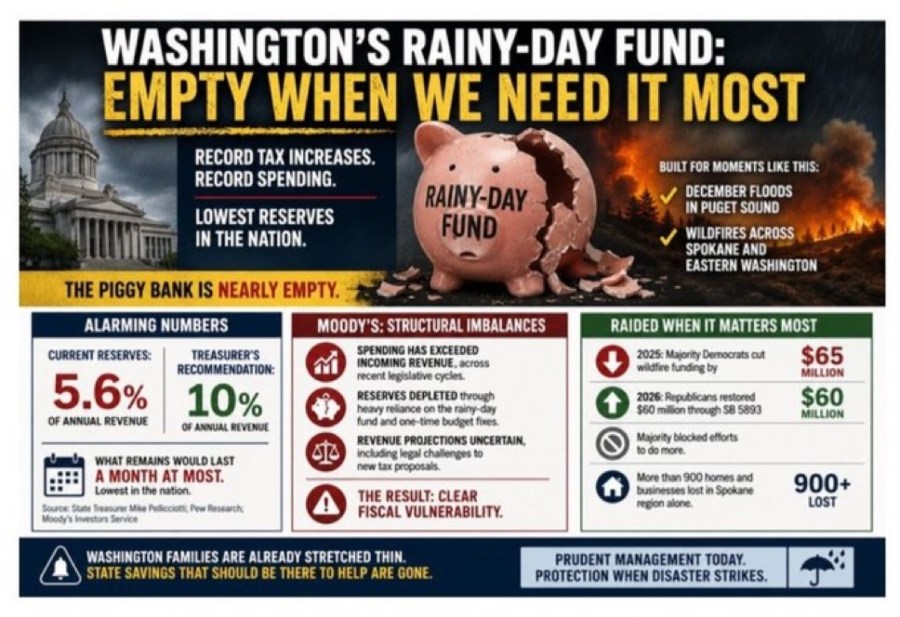
Opinion: Washington State’s rainy day fund won’t help fire victims
August 16, 2026
Rep. John Ley says Washington’s reserves sit at about 5.6 percent, the lowest in the nation, leaving little for wildfire relief.
Washington’s Rainy Day Fund Empty as Wildfires Rage
Rep. John Ley, LD-18, says poor fiscal management is one culprit
In the past two legislative sessions, Olympia Democrats pushed through the largest tax increases in state history. At the same time, the Democrat majority raided the rainy-day account down to the lowest reserves in the nation. What remains would last the state a month at most. Moody’s and other nonpartisan budget watchdogs are sounding the alarm.
Pew Research and financial tracking groups rank Washington at or near 49th or 50th in the nation for total reserve percentages relative to tax revenues. State Treasurer Mike Pellicciotti has said his office advises maintaining reserves at no less than 10 percent of annual revenue. Current levels sit at about 5.6 percent. “That means only about 5.6 percent is sitting in reserves right now, and it needs to be higher,” he noted. “It’s the lowest in the country.”
Moody’s points to structural imbalances: spending has exceeded incoming revenue across recent legislative cycles; reserves have been depleted through heavy reliance on the rainy-day fund and one-time budget fixes; and revenue projections remain uncertain, including those tied to legal challenges over new tax proposals. The result is clear fiscal vulnerability.
A healthy rainy-day fund exists precisely for moments like this — December floods in the Puget Sound region or the wildfires now burning across Spokane and much of eastern Washington. Sadly, the piggy bank is nearly empty.
In 2025, majority Democrats cut $65 million from wildfire funding. I supported Senator Shelly Short and fellow Republicans in 2026 when we restored $60 million through SB 5893. The majority blocked our efforts to do more. Instead, they raided a $4 billion retired firefighters’ pension fund and redirected the money toward wasteful spending, including bicycle education programs.
Washington families are already stretched thin — everything costs too much. Now more than 900 homes and businesses have been lost in the Spokane region alone. Rebuilding will take billions of dollars and years of recovery. State savings that should have been available to help are gone.
Olympia is not broke. It collects record revenues and spends at record levels in an $80 billion budget. Two former Democratic governors have acknowledged the reality: Democrats lack fiscal discipline and suffer from a spending addiction.
Budgets reveal values, priorities, and results. That is why I support a no-new-taxes balanced budget that cuts billions in waste while protecting rainy-day reserves, healthcare funding, schools, and public safety. The majority chose higher taxes and continued wasteful spending. The outcome has been deeper deficits and too little to show for the people we serve.
Wildfires do not care about party labels. The devastation they leave is immense. This is a moment to set partisan bickering aside and do what is right for Washingtonians. I support prioritizing emergency response funding, holding arsonists accountable, and protecting air quality, property, and lives.
Every Washington citizen deserves access to relief in their darkest hour.
I am grateful that President Trump and the Governor are working together on this crisis, and I stand ready to pursue bipartisan solutions going forward.
Washington State
THE PIGGY BANK IS NEARLY EMPTY
Opinion: Washington State’s rainy day fund won’t help fire victims
August 16, 2026
Rep. John Ley says Washington's reserves sit at about 5.6 percent, the lowest in the nation, leaving little for wildfire relief.
Washington State revenue officials: Income tax will bring in more money than first expected
New estimates show $3.1 billion in the next budget would be lost if voters pass Initiative 645 and eliminate the new levy on higher earners.
August 12, 2026
A new analysis from the state Department of Revenue shows Washington’s high-earner income tax will be paid by thousands of additional households and produce hundreds of millions of dollars more than previously assumed — if voters don’t ditch it this fall.
These larger figures will be in front of voters as they decide whether to repeal the tax in the Nov. 3 election. If voters uphold the tax, it could mean lawmakers need to make fewer cuts to balance the next two-year budget.
When Gov. Bob Ferguson signed legislation creating the income tax in late March, he and lawmakers counted on it to generate $2.7 billion for the next budget and $6.9 billion for the following two-year fiscal cycle.
Now, three months before an initiative to repeal the tax appears on ballots statewide, the department has revised its numbers, predicting this new levy will bring in $3.1 billion in the initial fiscal year and roughly $8.3 billion in the 2029-2031 biennium.
The new estimates appeared without notice last month, tucked into a chart in the online statement describing the potential fiscal consequences of Initiative 645. The revenue agency did the calculations and the Office of Financial Management wrote the document, which will be in voter pamphlets in October.
Initiative 645 seeks to repeal the 9.9% tax on individual and household wage income above $1 million a year, which is slated to take effect Jan. 1, 2028, with payments due the following year.
Because a “yes” vote on I-645 would eliminate the tax, the projected collections are portrayed as losses in the online statement.
The Department of Revenue analysis also found that 25,000 households would pay the income tax, up from 21,000 discussed during the last legislative session. That information is not in the fiscal statement prepared for voters.
Ferguson, a vocal opponent of the initiative, oversees both the Office of Financial Management and Department of Revenue but was not involved in the development of the document, officials said.
Narrower budget gap?
The added dollars would be welcome for Ferguson and lawmakers who expect to wrestle with a strained budget in the next legislative session. The governor has warned of a shortfall for a third straight year and asked agencies to take a hard look at spending.
But the money can’t be counted on quite yet.
Operating budgets must be based on official revenue forecasts prepared by the state’s chief economist and adopted by the Economic and Revenue Forecast Council.
For his June forecast, chief economist Dave Reich followed past practice and used the Department of Revenue estimates in the extensive fiscal note for the income tax legislation. That meant he assumed 21,000 filers and tax collections of $2.7 billion for the next budget.
The September forecast will be the first to potentially include the higher sums calculated by Ferguson’s revenue office.
“We will be taking a look at how they forecasted the tax but our forecast may or may not match depending on our assessment of the method, risk, etc.,” Reich said in an email.
An updated forecast won’t matter if voters pass Initiative 645 in November. And even if the measure fails, a legal challenge to the tax’s constitutionality could stanch this revenue stream.
The revenue department’s statement makes no mention of its earlier estimate that was part of the June forecast or what it could mean if the chief economist does not assume the new, larger figures in the next forecast.
Nor is there much explanation for why the figures are so much higher.
Washington State
9.9% STATE INCOME TAX
Washington State revenue officials: Income tax will bring in more money than first expected
New estimates show $3.1 billion in the next budget would be lost if voters pass Initiative 645 and eliminate the new levy on higher earners.… pic.twitter.com/qMOTTPgqF0
As usual, State Democrats are already estimating and spending money they don’t have today, will not have until 2028, and may not ever have if the State Voters vote to repeal the Income Tax. Everything about this is a huge pack of Lies.
A PATTERN OF CORRUPTION
A $1.87 Billion Experiment with NO Controls
The Billion-Dollar Bypass: $900k in White Guilt Tax Passed Through to Unvetted Orgs, Many Criminal “Damning” King County audit shows criminals and fraudsters control billions meant for at-risk youth.
Auditor sounds the alarm over internal opposition … as another $1.7B set to disappear out the door
By The Journal 425 (J425) July 30, 2026
SEATTLE – The Best Starts for Kids levy was a self-assessed voter tax meant to (make up for George Floyd) transfer property taxes from King County tax payers to nebulous categories like “youth non violence” among other things. The voters said yes.
A “Racism is a public health crisis” proclamation from Dow Conststine greased the wheels, eliminating oversight and red tape in a rush to get funding to the source of the issue. And organizations like Community Passageways and SE Network Safety Net were ready to receive that funding. Of course. SE Network Safety Net went down when its founder was indicted in the sweeping federal Jackson Drug Trafficking Organization case – they lost their school safety contract after that.
And Community Passageways has seen unarmed Black teens murdered in two locations where they were responsible for safety, not to mention the $800,000 their bookkeeper blew on gambling, Nordstrom and persons mortgage payments. Unfortunately these are just two of many examples of the wasted and lost funding distributed by King County DCHS.
But it’s the sheer volume that’s so daunting: $500 million in four years was fire hosed out of property value and into the DCHS, to be quickly distributed to pretty much anyone with a non-profit and a two sentence mission description that fit somewhere close to the intent of the measure. A King County auditor’s report brought this to light last Fall. J425 revisits the story now.
KING COUNTY DCHS — Hundreds of millions already lost to graft, corruption and theft. Authorized attempts to institute much-needed financial controls are met with internal indifference. As funds blow out the door by the hundreds of millions …
With investigations stalled, safeguards unimplemented and another billion about to go out the door… is King County running the perfect modern day patronage system?
Or are we in the midst of the biggest ongoing public corruption scandal in state history? Read the J425 summary of the audit findings here.
King County Auditor Blows Whistle: Millions Missing, Billions at Risk in DCHS Fraud Scandal
Read full story
While the King County Auditor sounds increasingly urgent alarms over “stagnated” investigations and “likely fraud,” the county is preparing to distribute a record-breaking $1.71 billion in grant funding this year.
To the casual observer, the Department of Community and Human Services (DCHS) appears to be a department in crisis, struggling to track millions of dollars in taxpayer funds.
But a closer look at the consistent outcomes—and the fierce internal pushback against oversight—suggests a different conclusion: the system is not broken; it is working exactly as designed.
They say you can tell the purpose of any system by its output.
Thus, the theory of “institutionalized patronage” suggests that the primary function of this billion-dollar pipeline is not necessarily the efficient delivery of services, but rather the systematic redistribution of wealth to a specific activist constituency.
In this model, the lack of financial stewardship is not a bug, but a feature that ensures the “spigots of cash” remain open to the political base of those in power.
Outcomes as Evidence
If the purpose of a system is defined by its outcomes, the DCHS outcomes are clear. Despite a “culture” of poor supervision and what the Auditor describes as “improper acts and payments,” the volume of funding only increases.
Washington State
A PATTERN OF CORRUPTION
A $1.87 Billion Experiment with NO Controls
The Billion-Dollar Bypass: $900k in White Guilt Tax Passed Through to Unvetted Orgs, Many Criminal "Damning" King County audit shows criminals and fraudsters control billions meant for… pic.twitter.com/azhAn6OQZH
MILLIONS FOR MAYHEM: HOW THIS SEATTLE NON-PROFIT TURNED TAXPAYER CASH INTO A CRIME WAVE
Seattle Public Schools doubled down on Community Passageways even as auditors uncovered forgery, missing millions, and an unguarded campus on the day students were killed.
By The Journal 425 (J425) August 15, 2026
While Community Passageways pocketed tens of millions to stop school violence, its staff were busy embezzling, running guns, and abandoning their security posts for offsite conferences. Teens died on their watch.
The non-profit’s finance director looted nearly nine hundred thousand dollars of public cash to fund casino sprees and shopping trips at Nordstrom.
Meanwhile, the organization’s celebrated violence interrupters built a parallel rap sheet featuring armed home burglaries, active domestic violence orders, and federal gun-running convictions. Subcontracts went straight to registered sex offenders with forged credentials.
Contracted to protect Garfield High School and achieve zero campus shootings, the entire safety team blew off their posts June 6, 2024 to attend a violence prevention conference at Lumen Field.
Left completely unguarded, the parking lot became a murder scene where seventeen-year-old Amarr Murphy-Paine was gunned down during lunch.
Instead of shuttering the operation, Seattle Public Schools extended the contract while CEO Dominique Davis promised everyone would show up next time.
Washington State
Mayhem, Madness, and Millions
MILLIONS FOR MAYHEM: HOW THIS SEATTLE NON-PROFIT TURNED TAXPAYER CASH INTO A CRIME WAVE
Seattle Public Schools doubled down on Community Passageways even as auditors uncovered forgery, missing millions, and an unguarded campus on… pic.twitter.com/KuQdoYtzhG
Taxpayer money squandered on Green Energy, illegal alien support, 24/7 monitoring of crab fishermen, and juvenile detention that leaks like a sieve. With an Income Tax coming down the pike, and Revenue Department hiring a whole new department of bureaucrats to collect the new tax, Washington goes deeper and deeper into the hole of deficits, with no end in sight. In fact, if the Democrats do cheat their way to a super-majority, the taxpayers of Washington have a very sorry future to look forward to, with rising crime, deteriorating infrastructure, and a heavier and heavier tax burden. Oh, and homeless tents in every neighborhood, next door to the Permanent “Supportive Housing.”
I would like, finally, to give a HUGE vote of THANKS to my Internet friend Susan Dupres, who spends hours of her time compiling so many of these reports on what is going on in Olympia. Our government hates us and oppresses us, and we would be much poorer if it weren’t for Susan’s valiant efforts on our behalf.