Huntington had a very intriguing life, and accomplishments.
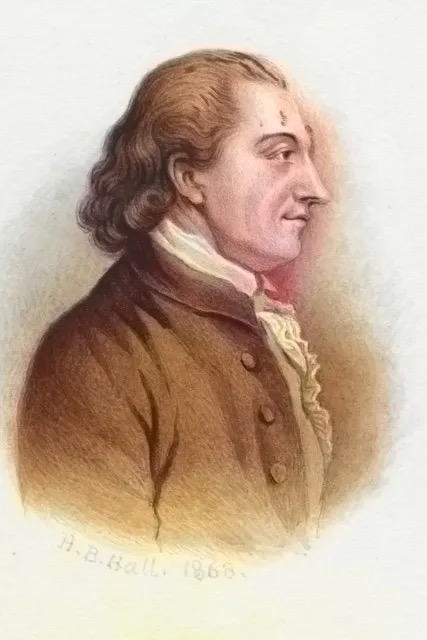
Samuel Huntington, born in July 1731 in Windham, Connecticut, was a lifelong public servant devoted to the cause of American independence. Raised on his family’s 180-acre farm, Huntington received his early education in local public schools and grew up in what would now be considered a middle-class household.
He initially apprenticed as a laborer making barrels and casks, but turned his interest toward law. Teaching himself with borrowed books, he was admitted to the bar at age 23 and earned such a strong reputation that he was appointed King’s Attorney for Connecticut.
Huntington’s political career advanced quickly. He served in the Connecticut Assembly and, by the mid-1770s, opposed British laws aimed at suppressing colonial resistance. He was elected to the Second Continental Congress, where he signed the Declaration of Independence and supported the Articles of Confederation.
From 1779 to 1781, he served as president of the Confederation Congress, the legislative body that governed the U.S. during the Revolutionary War. After the war, he returned to Connecticut, where he served on the state’s Supreme Court and as lieutenant governor.
In 1786, Huntington was elected governor of Connecticut, a role he held until his death in 1796. His administration focused on educational reform and opposing the slave trade.
Huntington died in office on January 5, 1796, at age 64, after almost a decade serving as governor. Though he and his wife, Martha, had no children, his legacy endures as one of service, integrity, and dedication to the founding of the nation.
Now, for some heretofore-unknown information on Mr. Huntington. I admit, this was new to me. And you?
There’s a real argument that the first President of the United States was not George Washington. It was a self-taught farm boy named Samuel Huntington, and almost no one remembers him. Here’s the story.
He was born in Connecticut in 1731, the son of a farmer. Not poor, but not the kind of family that sent sons to Yale or Harvard. And in fact, several of his brothers did go to college. Samuel didn’t. He stayed back and worked the farm. But he refused to let that be the end of it. The family minister let him borrow books from his personal library, and Samuel taught himself. No tutors, no university, just a farm kid grinding through borrowed books by candlelight. He set his sights on the hardest target he could pick, the law, and in 1754 he taught himself well enough to be admitted to the Connecticut bar. A self-educated farmer became a lawyer entirely on his own.
He rose through Connecticut politics and got sent to the Continental Congress. He nearly didn’t make it, he caught smallpox in Philadelphia, but he recovered and signed the Declaration of Independence in 1776, putting his name on a document that could have gotten him hanged. Then comes the part that should be famous. In 1779 his peers elected him President of the Continental Congress. And here’s the kicker. He was still holding that office in March 1781 when the Articles of Confederation finally took effect and the nation officially became “the United States in Congress Assembled.” Which means the first man to preside over the country under that name, the first to be called President of the United States in Congress Assembled, was Samuel Huntington. Years before Washington was sworn in.
It is why some people argue, with a real paper trail behind them, that he was technically the first President of the United States. He wasn’t done. He became chief justice of Connecticut’s supreme court, then governor of Connecticut, and he held that office right up until he died in 1796, becoming the first sitting US governor to die in office. A farm boy who never went to college, taught himself law from a borrowed library, signed the Declaration, and may have been the first president the country ever had. Samuel Huntington. The first president you were never taught about.
What do you think about the different portrait with this post? I like it better.
Happy 250th Birthday, America!
 Calling-all-RushBabes