
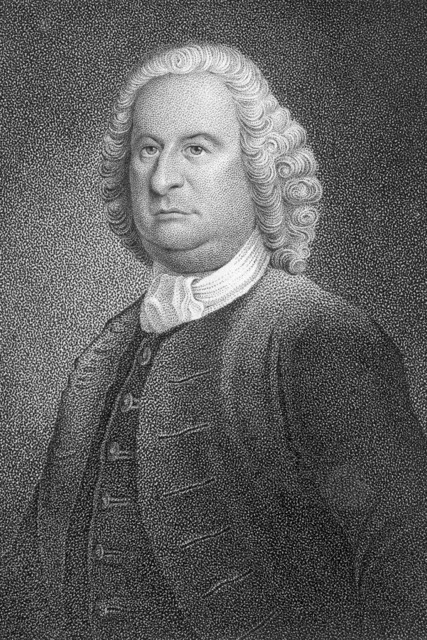
Philip Livingston, born on January 15, 1716, in Albany, New York, hailed from the wealthy and influential Livingston family. Philip spent his youth in opulent manor houses and townhomes before attending Yale College in the 1730s. After graduating, Philip settled in New York City and soon became one of the town’s most successful merchants. By the 1750s, Livingston entered public life, serving as an alderman and then elected representative within the British colonial government.
By the 1760s, British taxes designed to increase government revenue began to become unpopular with many American colonists. Livingston began to speak out publicly against these attempts at levying taxes on colonists without representation in Parliament. While resisting violent acts of protest, he attended the Stamp Act Congress of 1765.
Defeated for reelection in the colonial assembly by fierce British loyalists, Livingston was free to devote more of his time to the Patriot cause. In 1774, he was selected by members of his community to join the New York delegation in the First Continental Congress. Livingston was largely skeptical of American independence, his concerns of unprecedented levels of disorder often outweighing his desire to see British authority limited. He was not alone. The New York Assembly, under pressure to seek reconciliation, delayed in conveying their instructions to their delegates to the Continental Congress. When permission was finally received from New York, Livingston joined the rest of his colleagues and signed the Declaration of Independence one month late—on August 2, 1776.
Philip Livingston died of an illness two years later, at the age of 62. He left behind his wife, eight children, and a legacy of measured but steadfast patriotism.
This man had eight children! I wonder how many of his descendants are still around. Also, please note the photo at the top of this post, then look at the photo with the next post on his life. It doesn’t even look like the same person. Age brings changes.
One of the richest men in all of America signed the Declaration of Independence knowing it could cost him everything. Then he left home to serve, died far away in a borrowed town, and never came back. Meet Philip Livingston.
This guy was not a scrappy underdog. Just the opposite. He was born in 1716 into the Livingston family, one of the wealthiest, most powerful dynasties in colonial New York. Manor lands, a Yale education, and a shipping empire he built into one of the biggest merchant fortunes in New York City. He had everything the British system was designed to reward.
And he spent that fortune building things that still exist. He helped found King’s College, which you know today as Columbia University. He helped start the New York Society Library. He helped create the New York Chamber of Commerce. The man was basically constructing the civic backbone of New York with his own money and time.
Here’s the thing though. He was not some hothead revolutionary. He actually feared independence. He worried it would bring chaos and disorder, and he was cautious about the whole idea for a long time. This wasn’t a man itching to burn it all down.
But when New York finally gave its delegates the go-ahead, Livingston signed. He put the name of one of the great fortunes in America onto a document the crown treated as treason. A rich man betting his wealth against the empire that made him rich.
And the war came straight for him. When the British took New York, they seized and used his properties. He started selling off his holdings to help fund the fight, watching the empire he’d defied pick apart the life he’d built.
Then comes the ending that gets me. His health was failing, and he knew it. Congress had been driven out of Philadelphia and was meeting in the small town of York, Pennsylvania. Livingston could have gone home to rest. Instead he told his family he probably wouldn’t see them again, and he went to York to keep serving anyway.
He died there in June 1778, in the middle of a session of Congress, far from home. He’s buried in York, Pennsylvania to this day. He never made it back to the New York he spent his whole life building.
A man who had every reason to stay comfortable and loyal, who gave his fortune and his final months to a country he wasn’t even sure would work.
Philip Livingston. He died at his post, a long way from home.
The portrait above is a much younger man. The two different takes on his life are fascinating.

